
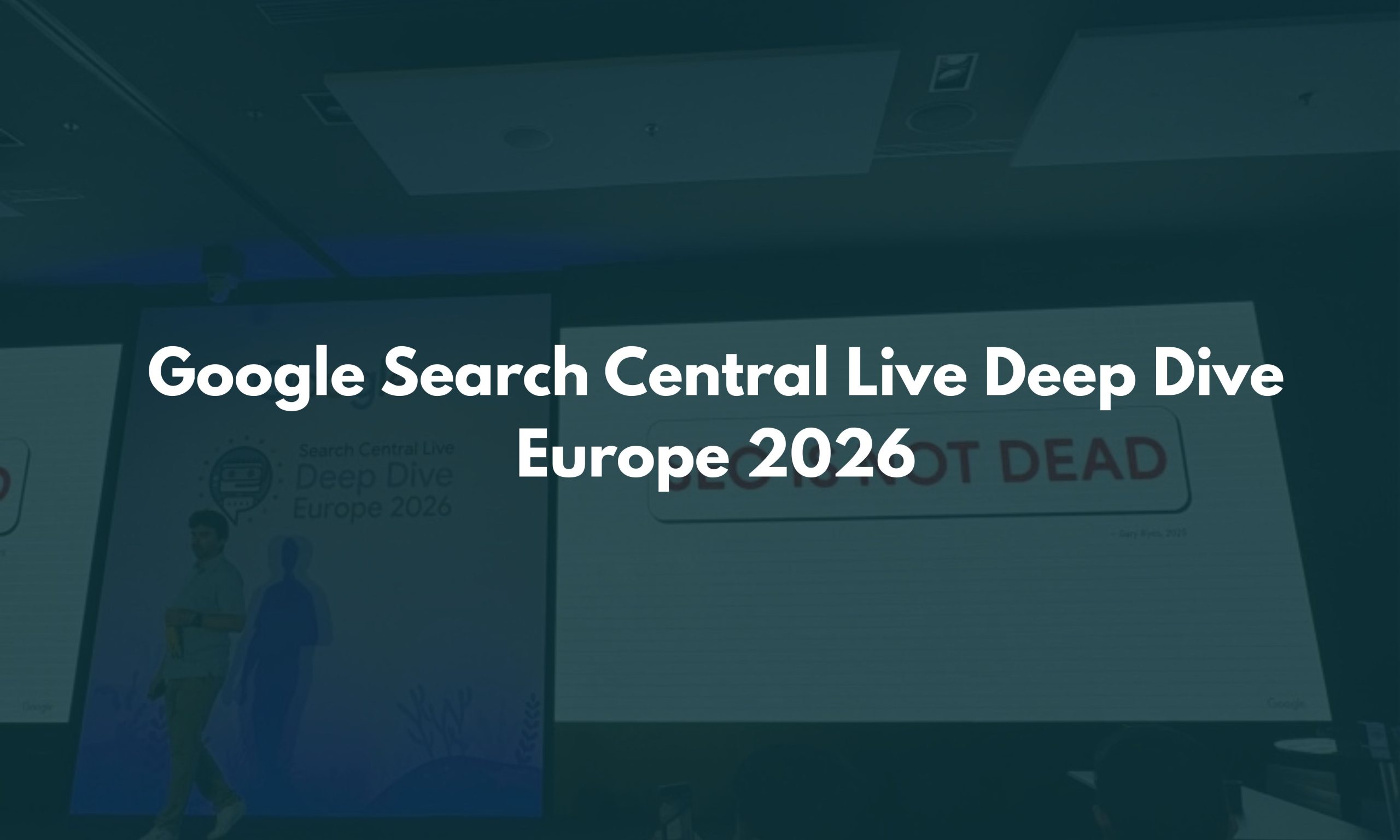
Google Search is undergoing a rapid shift. However, the message from Google Search Central Deep Dive Europe 2026 has been loud, clear, and highly consistent – The emergence of AI Search DOES NOT make conventional SEO irrelevant! Rather, AI Search requires deep-rooted, robust SEO fundamentals.
The event was held in Barcelona over three days. It brought together both Google Search teams and SEO experts to discuss ranking, AI Mode, indexing, crawling, structured data, Search Console, international SEO, as well as the future of Search.
One prominent theme that kept resurfacing across all the sessions is that Google’s AI-backed search features are heavily relying on traditional Search elements.
Renowned SEO consultant Lucian Harhata shared his insights on LinkedIn: “AI Overviews and AI Mode are built on the same foundations as classic Search: crawling, indexing and serving.” In simpler terms, it would be wrong to state that GEO or Generative Engine Optimisation is a completely new discipline. One should think of it as an extension of doing SEO well.
Google Search isn’t going anywhere. People are searching differently!
The President of Google Iberia, Lino Cattaruzzi, inaugurated the event with a quote from Google’s co-founder Larry Page: “The ultimate search engine would understand exactly what you mean and give you exactly what you want.”
It took almost two decades to make that vision increasingly relevant to AI-backed Search.
Google shared multiple statistics that show how user behavior is shifting rapidly. Currently, more than 5 trillion searches are taking place on Google annually. Around 94% of frequent LLM users now also use Google Search more often.
AI Mode searches are eventually becoming more and more conversational. Generally, an average AI Mode query tends to be three times longer than a usual traditional Google query. Follow-up queries, too, have increased by approximately 40% month over month ever since AI Mode was launched.
Gary Illyes has shared that 1 out of 6 AI Mode searches is multimodal in nature. Meanwhile, searches consisting of 5 or more words are growing 1.5 times faster as compared to shorter queries.
Another important shift is that the nature of these searches is also changing fast. “Exploring” searches are becoming more prevalent. Planning-oriented queries are growing by a whopping 80% while “which” searches are rising 40% faster.
All these changes have just one implication for content marketers – you need to focus on answering specific questions very well rather than working on isolated keywords.
AI Search still relies on SEO fundamentals
The most reassuring takeaway from this event is that Google isn’t asking SEO professionals to throw their hard work and experience down the drain.
Natalia Granath insisted that there is no particular system that simply decides whether a piece of content is human or AI-generated. Rather, the focus is on the quality and usefulness of the content.
This differentiation is much needed. Human-written content can still be poorly written, while AI content can also be potentially useful. What Google is concerned about is low-value, bulk content published to manipulate rankings.
The same principle is applicable to AI Search too. The content still needs to be indexable, crawlable, understandable, readable, and most importantly, beneficial to the users. This is exactly why it won’t be wrong to say that good SEO is basically good GEO.
Another thing content marketers and SEO professionals need to understand is that there’s absolutely no need to “chunk” content just for the sake of making it AI-system-ready. A piece of content is still required to be written for humans first, while focusing on specific details with clarity.
AI-backed SEO? Yes, but humans are still the decision-makers!
The community lightning talks came up with practical solutions on how SEO experts can actually use AI.
James Powley, the SEO Director at Blye Array, showed AI workflows that successfully cover content auditing, competitor analysis, post-migration analysis, and even creating recommendation mockups. This workflow is highly beneficial as it enables humans to establish the right parameters and interpret the results, while allowing AI to manage repetitive analysis and evaluation. The final decision still lies with humans, as they get to decide the next steps.
This distinction definitely plays a crucial role as AI is increasingly penetrating into SEO systems.
Victoria Yap looked into the boundary between human judgement and AI automation, segregating SEO activities into ones that need automation, the ones that require augmentation, and the ones that need human intervention.
The overall message is loud and clear — use AI but never as a replacement for human judgement.
Technical SEO is NOT less significant!
The event emphasized the fact that technical SEO remains relevant even in an AI-centric Search ecosystem.
Liv Day, the Client Partner at Digiloft, shared the importance of JavaScript crawlability, accessibility, and structured data in the context of Search evolution. A crucial reminder was regarding a page that can “appear” to be complete in a browser. But this does not mean that Google has access to its content. Visibility issues can actually happen because of technical problems like non-crawlable links, blocked JavaScript or API resources, and content that depends on user interaction for visibility.
Originality, quality, and the end of commodity content
Nacho Mascort shared one of the strongest content-led perspectives. He believes that Google is working on improving the quality of content with its core updates. He highlighted that there are four significant dimensions to quality: effort, skill, originality, and accuracy.
Nacho also came up with an amazing text to detect “commodity content.” He has asked brands to replace their brand name with that of their competitors. Would the brand page still remain valuable? What will make that brand worth choosing?
This question seems all the more relevant, especially in an AI Search ecosystem where generic data can easily be produced in a fraction of a second.
The primary goal therefore, is to produce content that showcases your original insights, experience, expertise, and actionable insights.
AI affecting websites and search experiences!
Natalia Venditto of Adobe shared an interesting perspective too.
She has come up with the concept of “reframing,” i.e., embedding AI-generated apps into websites strategically.
This reframing indicates that AI is not just restricted to generative textual content. AI has been enabling websites to become more interactive, thereby creating exciting possibilities for users to discover, consume, and interact with content.
The bigger picture
Liv’s insights focused on one of the most commercially crucial discussions- SEO measurement.
Alex Wright has shared a case where search clicks went down by 65%, and queries increased by 17%. This shows that clicks alone are no longer relevant for SEO performance.
With AI answers, search agents, and multimodal searches, SEO professionals and brands should look beyond traditional SERP rankings and clicks.
Google Search Central Live Deep Dive Europe 2026: Impact on SEO
The takeaway is simple and uncomplicated.
The future of SEO does not require you to make a choice between AI Search and traditional Search. Rather, the need of the hour is to create websites and come up with content that is actually useful for your target audience and comprehensible to machines.
SEO, of course, is not something that goes obsolete with time. Rather, SEO is eventually becoming human-oriented, strategic, and technically demanding. Only those brands that blend strong SEO fundamentals with original, useful, and trustworthy content and create something that proves to be beneficial for both machines and humans are going to survive the AI wave.