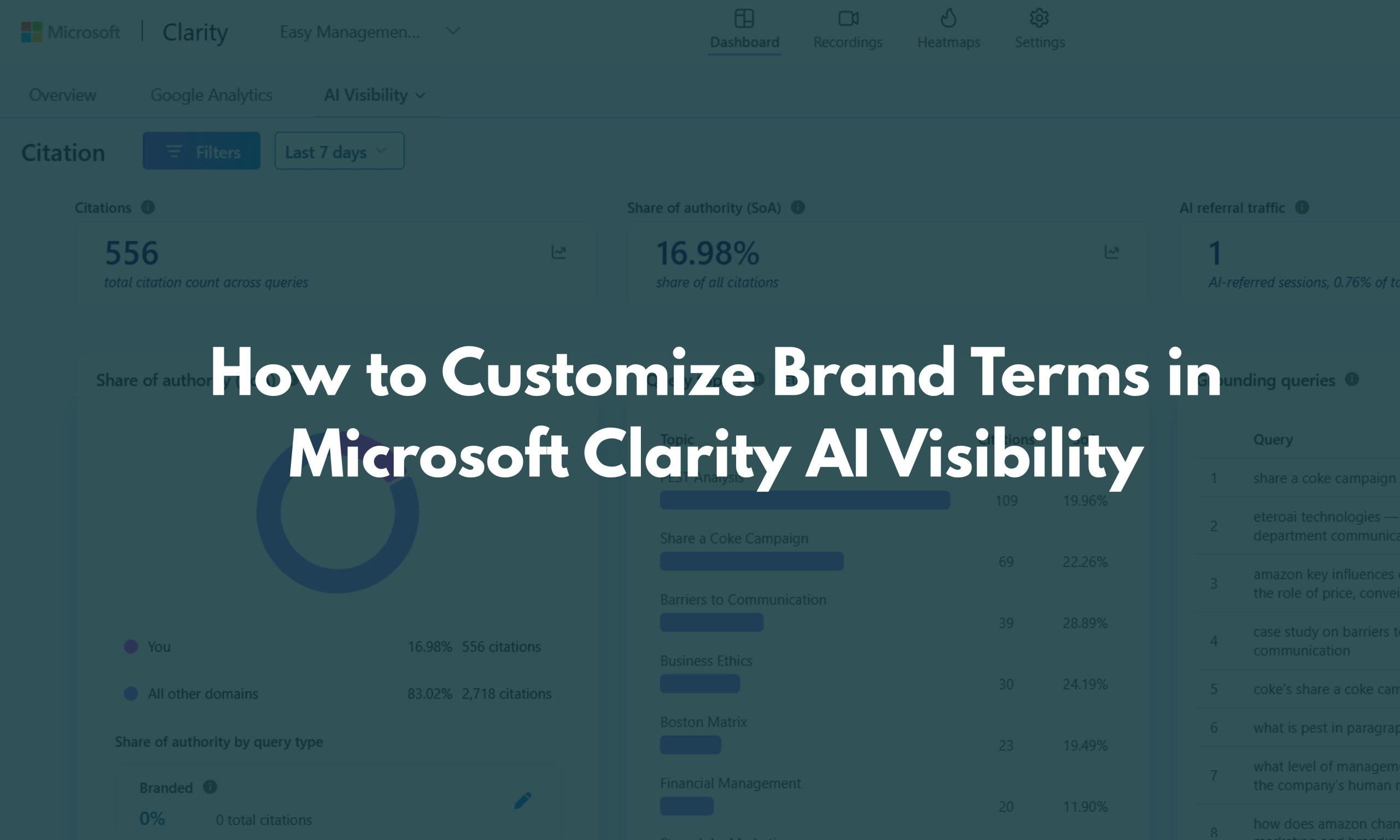
Microsoft Clarity now allows website owners to customize the Brand Terms used in its AI Visibility dashboard, giving teams more control over how AI-related queries are classified as branded or non-branded.
That matters because people—and the AI systems interpreting their requests—don’t always reference a company using its official name. They may use an abbreviation, product name, regional spelling, translation, shortened version, or even a common typo. Adding those variants to Clarity can make branded-versus-non-branded reporting more representative of how your business is actually discussed.
The update builds on Clarity’s earlier introduction of branded and non-branded query segmentation in its Citations dashboard. That segmentation is intended to help separate visibility associated with direct brand recognition from visibility earned through broader topical or category discovery.
What Are Brand Terms in Microsoft Clarity?
A Brand Term is a word or phrase that Microsoft Clarity can use when determining whether a query is associated with your brand.
Microsoft says users can now add, edit, and remove Brand Terms from:
Settings → AI Visibility
Clarity initially provides a pre-populated list, which can then be refined to better reflect the names people use for your organization, products, or services.
For example, suppose a hypothetical company is called:
Northstar Analytics
Its relevant Brand Terms might include:
- Northstar Analytics
- Northstar
- North Star Analytics
- NorthstarAnalytics
- NS Analytics
- A localized version of the company name
- Major proprietary product names
The goal isn’t to add every remotely related keyword. It is to define the language that genuinely identifies your brand.
Why Brand Term Customization Matters
Without customized Brand Terms, some queries that are effectively brand-specific can potentially look like generic discovery queries.
Consider these two examples:
Query A: “Northstar Analytics pricing”
This is clearly branded.
Query B: “NS Analytics pricing”
If “NS Analytics” is a commonly used abbreviation but isn’t recognized as a brand reference, the classification may not reflect the query’s actual intent.
Microsoft specifically recommends accounting for variations such as abbreviations, alternate spellings, localized names, translations, and common typos.
More accurate classification gives marketers a cleaner basis for comparing two different types of AI visibility.
| Query type | What it generally represents |
|---|---|
| Branded | AI queries that reference your brand, products, services, or other brand-specific terminology |
| Non-branded | Broader queries related to subjects your site covers without explicitly referencing your brand |
Microsoft describes non-branded visibility as a way to examine discovery based on broader topical relevance rather than direct brand recognition.
That distinction can materially change how you interpret the dashboard.
Branded vs. Non-Branded AI Visibility: What’s the Difference?
A high number of AI citations isn’t enough on its own to tell you why your content is appearing.
Imagine that two websites each receive 1,000 citations in tracked AI answers.
For the first site, most citations could come from queries containing the company’s name.
For the second, a large portion could come from category-level questions where users weren’t already looking for that company.
The headline citation number may look similar, but the discovery pattern is different.
Branded queries
Microsoft defines branded queries as cited queries mentioning your brand, products, services, or other brand-specific terms.
These queries can help indicate situations in which an AI system connects the user’s information need directly with your brand and retrieves your content as a supporting source.
Examples might include:
- “Microsoft Clarity heatmaps”
- “Clarity session recordings”
- “Northstar Analytics alternatives”
- “Acme CRM pricing”
Non-branded queries
Non-branded queries don’t explicitly mention the brand but relate to topics, services, products, or information its website covers.
Examples could include:
- “best way to analyze website heatmaps”
- “how to identify rage clicks”
- “how to measure citations in AI answers”
- “tools for analyzing session recordings”
Microsoft says tracking these queries can help teams understand where their content is being discovered because of topical relevance rather than an explicit brand reference.
For content and SEO teams, that can be an especially useful distinction.
How to Customize Brand Terms in Microsoft Clarity
Microsoft lets users manage Brand Terms from the AI Visibility settings area.
A sensible setup process looks like this:
Step 1: Review the Brand Terms Clarity already detected
Don’t immediately replace the pre-populated list.
Start by checking:
- Which company names are already included
- Whether important product names are represented
- Whether abbreviations are missing
- Whether irrelevant phrases have been included
Treat the automated list as a starting point rather than a finished taxonomy.
Step 2: Add genuine brand-name variations
Add variations people actually use when referring to your business.
These may include:
- Official company name
- Shortened company name
- Established abbreviation
- Major product names
- Alternate spelling
- Translated name
- Regional brand name
- Known misspelling
Microsoft explicitly identifies abbreviations, alternate spellings, localized names, translations, and common typos as possible Brand Terms.
Step 3: Group related Brand Terms under a Brand Name
Clarity lets you organize multiple Brand Terms beneath a broader Brand Name.
Microsoft gives the example of a Brand Name such as Microsoft containing terms including “Microsoft,” “MS,” and “Microsoft Corporation.”
This hierarchy can make reporting easier to manage when a business has several ways of being referenced.
| Brand Name | Associated Brand Terms |
|---|---|
| Acme | Acme, Acme Inc., Acme Software |
| Acme CRM | Acme CRM, AcmeCRM |
| Acme Analytics | Acme Analytics, Acme Insights |
Step 4: Be cautious with ambiguous abbreviations
This is one of the most important practical checks.
An abbreviation may be closely associated with your company internally while also having several unrelated meanings in the wider market.
For example, a two-letter acronym could refer to:
- Another company
- An industry term
- A location
- A technology
- A professional certification
Adding an overly broad term could make your branded data less meaningful.
The objective should be accurate classification, not maximizing the number of queries labelled as branded.
Step 5: Review Brand Terms periodically
Brands change.
You may:
- Launch a new product
- Retire a service
- Acquire another company
- Rebrand a product
- Enter another country
- Change a product’s spelling
- Become widely known by a new abbreviation
Microsoft recommends keeping Brand Names and Brand Terms updated so Clarity can more accurately recognize brand-associated queries.
A quarterly review is a reasonable internal process for active brands, with additional checks after major launches or rebrands.
What Should You Include as a Brand Term?
A useful rule is:
Add a term when its presence in a query is a meaningful signal that the query is specifically about your brand.
Usually worth considering
- Legal business name
- Customer-facing brand name
- Widely used short name
- Recognized abbreviation
- Proprietary product names
- Distinctive service names
- Established translations
- Frequent brand misspellings
Usually worth reviewing carefully
- Extremely generic product terms
- Category names
- Generic service descriptions
- Broad industry abbreviations
- Names shared by several unrelated brands
- Competitor names
For instance, if you sell accounting software, adding “accounting software” as a Brand Term would undermine the distinction between brand demand and category discovery.
It describes the market, not your brand.
Brand Name vs. Brand Term
Microsoft Clarity distinguishes between a Brand Name and the individual Brand Terms associated with it.
Think of the Brand Name as the reporting group.
Brand Terms are the phrases underneath it that people may use.
Example
Brand Name: Microsoft
Possible Brand Terms:
- Microsoft
- Microsoft Corporation
- MS
Microsoft says users can filter at the Brand Name level to see results covering its associated terms or select an individual term for more granular analysis.
That makes the hierarchy useful for businesses with multiple brands, products, or naming conventions.
How to Use the Data After Configuring Brand Terms
Improving the Brand Terms list is only useful if the resulting segmentation informs decisions.
Here are several practical analyses to run.
1. Compare branded and non-branded citation trends
Start by checking whether citation visibility comes primarily from brand-specific queries or broader category queries.
Microsoft added branded and non-branded filtering specifically to make this separation easier in the Citations dashboard.
A rise in branded citations and a flat non-branded trend tells a different story than growth across both segments.
Don’t automatically treat one as “better.” They represent different types of visibility.
2. Examine Share of Authority separately
Clarity provides Share of Authority metrics for branded and non-branded queries.
For branded queries, Microsoft documents the calculation as:
Your domain’s branded citations ÷ total citations from all domains for branded queries × 100
This provides another way to examine your citation presence within the query set Clarity tracks.
Comparing the two segments can highlight areas worth investigating.
For example:
- Strong branded visibility + limited non-branded visibility
- Limited branded visibility + growing topical discovery
- Strength in both groups
- Decline isolated to a particular query type
The interpretation should depend on your business model, market maturity, content strategy, and the queries involved.
3. Look at the actual grounding queries
One important caveat: the queries displayed in Clarity are grounding queries, not necessarily an exact transcript of what a person typed into an AI assistant.
Microsoft explains that these are queries AI systems use when retrieving supporting content before producing an answer, and that they may differ from the user’s original wording.
That distinction prevents a common analytical mistake.
Treat the queries as evidence of how AI retrieval systems are finding and categorizing information—not automatically as conventional keyword-volume data.
4. Identify cited pages connected with non-branded discovery
Clarity’s Citations dashboard also shows which pages on your domain appeared as sources in AI-generated answers.
Combine that information with non-branded queries.
Look for pages that repeatedly earn citations for broader questions.
Then ask:
- What topic does this page explain particularly well?
- Does it answer a distinct problem?
- Is its structure easy to extract information from?
- Does it contain original examples or data?
- Are related pages missing from the site?
- Could the subject be supported with additional first-hand expertise?
The goal shouldn’t be to mechanically copy the page’s format across hundreds of articles. Focus on original value, substantial topic coverage, expertise, trust, and content created primarily to help visitors.
5. Investigate branded queries you didn’t expect
Custom Brand Terms can also reveal interesting brand-language patterns.
You may discover that people or AI systems frequently refer to:
- An old company name
- A product abbreviation
- A shortened brand
- A product rather than the parent company
- A common misspelling
- A local version of your name
These patterns can be useful beyond Clarity.
They may influence:
- FAQ wording
- Product documentation
- Site search
- Entity descriptions
- Schema naming consistency
- Help center terminology
- Brand monitoring
Don’t change your brand language solely because a variant appears in a dashboard, but repeated patterns are worth investigating.
Common Brand Term Mistakes to Avoid
Adding generic keywords as Brand Terms
This can blur the line between direct brand interest and category discovery.
“Microsoft Clarity” is brand-specific.
“Website analytics” isn’t.
Adding every product-category variation
Brand Terms aren’t a conventional SEO keyword list.
A company selling running shoes shouldn’t classify every variation of “running shoes” as a branded term.
Ignoring misspellings people actually use
If a recurring misspelling clearly refers to your business, adding it may improve classification.
Forgetting local or translated brand names
International businesses may be referred to differently across markets.
Localized names and translations can be useful where they genuinely represent how the brand is referenced.
Treating AI visibility as traditional rank tracking
Clarity’s Citation dashboard doesn’t measure traditional search rankings, impressions, or click-through rate. It focuses on how pages are cited in AI-generated answers.
That means AI citation reporting should complement—not replace—your existing search analytics.
A Practical Brand Term Checklist
Before saving your Brand Terms, check each entry against these questions:
- Does this phrase clearly identify our company, product, or service?
- Do customers genuinely use this variation?
- Is it distinctive enough to represent brand intent?
- Could it commonly mean something unrelated?
- Is it a product name rather than a generic product category?
- Are important abbreviations included?
- Are known misspellings included?
- Are translations or localized names relevant?
- Have old or retired terms been removed?
- Can related variants be grouped under the correct Brand Name?
If a term creates more ambiguity than clarity, investigate before including it.
What This Update Means for AI Visibility Measurement
AI visibility reporting is becoming more useful as tools move beyond simple citation counts and provide context about why a brand appears.
Custom Brand Terms improve one part of that context.
They help distinguish:
“The AI system found us while dealing with a query that directly references our brand.”
from:
“The AI system found us while dealing with a broader subject where our brand wasn’t explicitly referenced.”
Those are related signals, but they answer different questions.
With a well-maintained Brand Term taxonomy, Clarity’s branded/non-branded segmentation can provide a clearer foundation for evaluating:
- Direct brand-related AI visibility
- Broader category discovery
- Citation patterns
- Content-topic strengths
- Share of Authority differences
- Changes in how AI retrieval systems associate queries with your brand
The key is classification quality.
Adding more terms isn’t necessarily better. Adding the right terms is.