
Are you frustrated seeing your pages unindexed even though your site is technically healthy? If yes, then the answer is simply: Google doesn’t find content on your pages valuable.
Throughout my journey as an SEO specialist, I have seen that most pages that don’t get indexed struggle because of content quality. And it’s quite obvious! Search engines prefer to have quality content that adds value, meets user intent, and search queries.
In this article, I would like to share my experience regarding the possible technical issues and the measures to fix those indexing issues.
To begin with, search engines index static pages and not dynamic ones. When it comes to non-indexed pages, the majority of the pages, which are highlighted as errors, are dynamic pages that contain different parameters and characters.
Below are the major issues that you can see in GSC, and different pages are added under these issues:
- Server error (5xx)
- Redirect error
- URL blocked by robots.txt
- URL marked ‘noindex’
- Soft 404
- Blocked due to unauthorized request (401)
- Not found (404)
- Blocked due to access forbidden (403)
- Crawled – currently not indexed
- Discovered – currently not indexed
- Alternate page with proper canonical tag
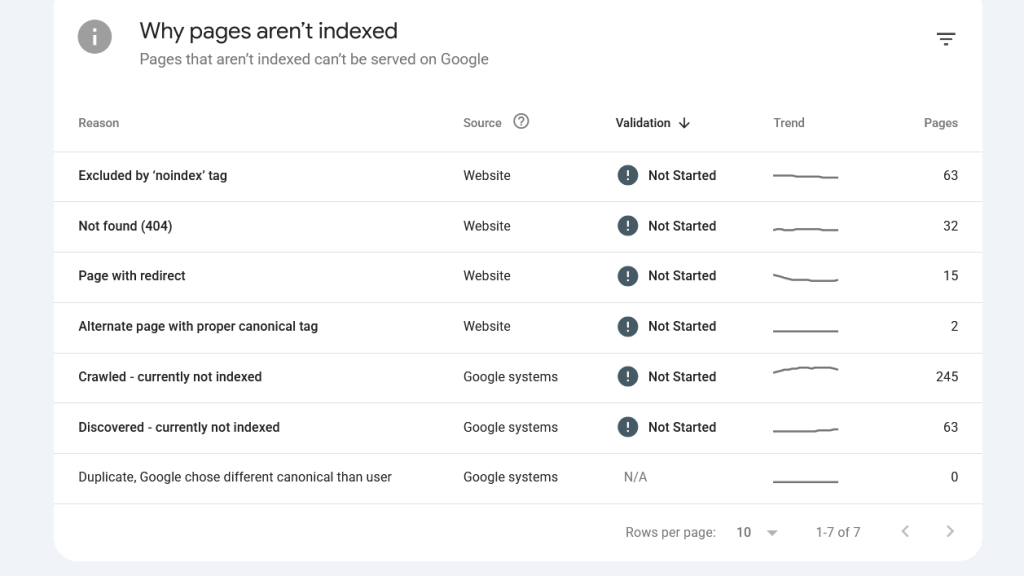
In my personal experience, the major issues which we need to take care of are 404 issues and the “crawled currently, but not indexed issue. No matter if it’s not a 404 or a normal 404, sometimes we see empty collection pages of products that are gone out of stock. They all fall under 404.
Suppose we make any changes to the URL and forget to add directions, then the URL will lead to a 404. So we need to check the URL and make the necessary adjustments by adding redirection to closely related pages. In fact, technically, this is not a huge issue. However, I just wanted to make sure users do not land on a broken page and bounce back from the website.
Why emphasise the current index? Because those pages are crawled and viewed by Google, they do not add that much value to users; search engines don’t prefer to index them. Thus, we can say that with multiple technical fixes and manual requests, the pages don’t get indexed. The reason is simply that the content on the page is not adding value to the users and the search engine as well.
Now the question arises: how to fix the pages and get them indexed?
So here is my experience so far – what I did, and what works for me the majority of the time.
- Add quality content, d preferably content that aligns with your users. You just need to understand the intent and purpose of the page and create the content accordingly. Also, it should be created by users and not by any AI tools or through automatic copy creation.
- Add trust signals such as reviews, testimonials, brand mentions, information, certifications, affiliations, user generated content on your page so that Google knows that the page really serves a purpose, and the website overall has a good reputation in a niche. This makes the page qualify to get indexed.
- Look into your XML sitemap and see if the pages are added there. If not, then make sure to include the page on the XML sitemap.
- Link the index pages to other webpages naturally, not forcing or linking the page unnecessarily; you just need to understand the intent, the keywords that fit, which match the intent of the page, and then link on the main pages, maybe the homepage or maybe the top-performing page.
- Do some competitor research. Check what the competitors are adding on their pages, and what works well for them. Based on that, optimise your content.
- Create backlinks to boost the authority of those URLs through guest posting on highly authoritative websites in the same niche. Over time, you’ll see some good changes.
These are some of the techniques I followed in my career to get the pages indexed easily in the search results. However, the results aren’t guaranteed, as it depends on your content quality and optimization, brand reputation, backlink profile, etc,
Finally, even after fixing all the technical issues, if your pages aren’t getting indexed or cited in Google search results, you should optimize them based on the value they provide to the users. If users don’t find content on your pages valuable, engagement remains low, and they don’t take any meaningful actions on your site. Again, such pages are less likely to get indexed in Google Search Console.
Try the methods mentioned above, and your page will get indexed.
Ref – https://support.google.com/webmasters/answer/7440203?hl=en#status_types

Kira Cube
Kira Cube, founder of Kira Diverse, brings over eight years of SEO expertise across on-page, technical SEO, CRO, local optimization, e-commerce growth, and content refinement. His approach blends data, experience, and AI-ready strategies that help brands grow with clarity and long-term impact.