
OpenAI has officially begun testing advertisements inside ChatGPT, marking a notable change in how the service may be monetised in the future. For the first time, sponsored content will appear directly alongside conversations for certain users — a move aimed at helping support free access and sustain the platform’s ongoing development.
This trial is being rolled out gradually, beginning in the United States and only affecting specific subscription tiers. Here’s a complete breakdown of what’s happening and how it may impact you.
Why OpenAI Is Introducing Ads
Deploying ads inside ChatGPT is part of OpenAI’s broader strategy to balance free access with the increasing cost of operating advanced AI systems. Supporting infrastructure and continuous development requires significant investment, and advertising helps contribute to that without forcing every user into paid plans. According to OpenAI, these ads are intended to make AI services more widely available without compromising quality or trust.
Who Sees the Ads (and Who Doesn’t)
At this stage of testing, ads appear only to a specific group of users:
- Logged-in adult users on the Free and ChatGPT Go subscription plans.
- Plus, Pro, Business, Enterprise, and Education subscribers will not see ads.
OpenAI has also stated that ads won’t appear for users it detects to be under 18 and won’t show up next to conversations about sensitive topics like health, mental wellbeing, or politics.
There’s even an option for some Free users to opt out of ads entirely in exchange for fewer free messages per day.
How Ads Are Displayed
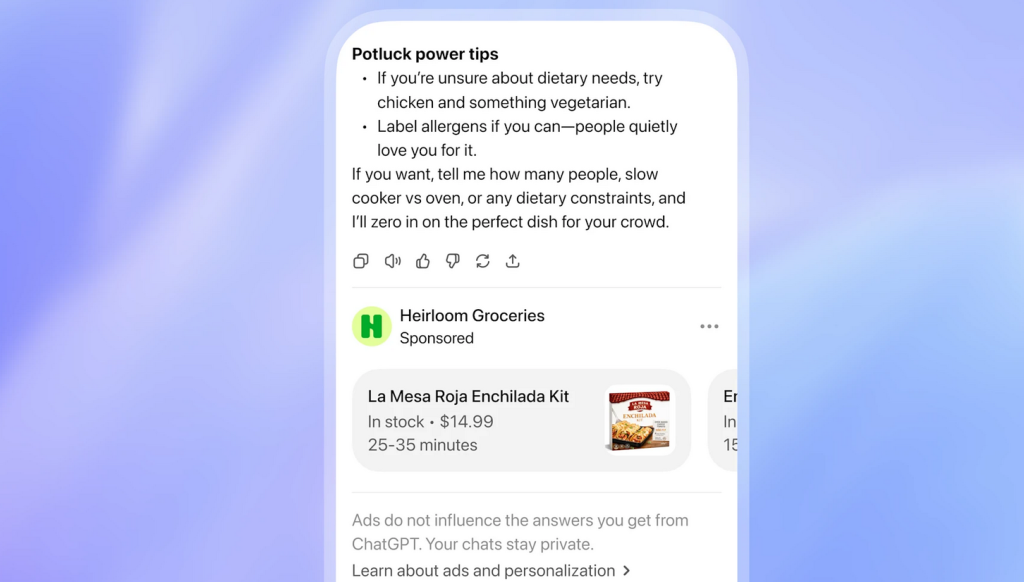
Image Source: https://openai.com/index/testing-ads-in-chatgpt/
Unlike traditional social media or search engine ads, ChatGPT’s sponsored placements are:
- Clearly labelled as advertisements
- Visually separated from the AI’s responses
- Placed at the bottom of the chat window, not inside the answer itself
OpenAI emphasises that the ads do not influence the answers ChatGPT generates — the model’s responses remain driven by what it predicts is most helpful to the user.
Personalisation and Privacy Protections
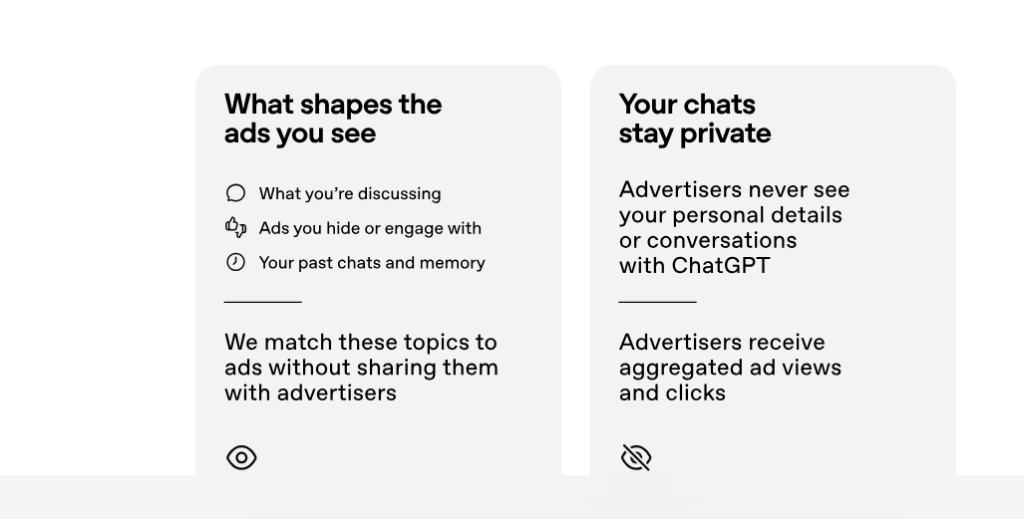
Image Source: https://openai.com/index/testing-ads-in-chatgpt/
One of the most common concerns around advertising is user data privacy. OpenAI’s approach has several key points:
- Advertisers cannot access private conversations, chat history or personal data.
- Targeting is handled by matching the topic of the conversation with relevant ads, meaning advertisers only see aggregate data like ad views and clicks.
For example, if you’re discussing pet care tips, you might see ads for related products, but no advertiser sees the actual content of your chats.
Users also have controls to:
- Dismiss ads
- Provide feedback
- Turn off ad personalisation
- Delete their ad data manually
What Advertisers Can Expect
Although this testing phase is early and limited, reports indicate that some major advertising networks and brands — including Omnicom, WPP, and Dentsu partners — are participating in the pilot. This suggests strong commercial interest in ChatGPT as a new advertising channel.
Additionally, it’s been noted that OpenAI is seeking to build systems to ensure the integrity and trustworthiness of ads, which includes safeguards against scams and misleading content.
What This Means for the Future
This test marks ChatGPT’s first real venture into advertising and may shape how future versions of the platform are funded and structured. Here are a few implications to consider:
- Broadening access to powerful AI tools without forcing paid subscriptions.
- New revenue sources for OpenAI beyond subscription fees.
- A potential new advertising channel where relevance is driven by actual user conversations, not just clicks or search terms.
At this stage, OpenAI’s official stance is that they want to learn and refine how ads work within this context before rolling them out more widely, indicating that the feature may evolve based on user feedback and performance metrics.
Conclusion
OpenAI’s ad experiment in ChatGPT represents a significant evolution in both the business model and user experience of conversational AI. While only a subset of users can currently see ads, the rollout highlights a potential future where AI services remain accessible and sustainable without sacrificing user privacy or answer quality.
Source
Testing Ads in ChatGPT — OpenAI Official Blog (February 9, 2026): https://openai.com/index/testing-ads-in-chatgpt/

Kira Cube
Kira Cube, founder of Kira Diverse, brings over eight years of SEO expertise across on-page, technical SEO, CRO, local optimization, e-commerce growth, and content refinement. His approach blends data, experience, and AI-ready strategies that help brands grow with clarity and long-term impact.